
Prevention

When a heart scan saves your life

February 1, 2018 | 3-minute read

Carrie jumping in celebration outside of Duke Medicine after hearing she is cancer free

In this article

When Carrie's physician recommended a cardiac CT calcium score, she had no idea it would inadvertently save her life.

The unexpected discovery

Carrie has always put her health as a top priority. An energetic, healthy woman, she eats right, loves to work out, always keeps up with her annual checkups, and has even completed a marathon. Carrie is an all-around healthy mom with little to worry about when it comes to her health.

However, when Carrie suddenly lost her sister, an autopsy revealed that a heart condition may have played a role in her untimely death. During her annual physical, she mentioned her family history to her HMG primary care physician, Dr. Elizabeth Palmer.

"I vaguely shared that with Dr. Palmer, who suggested I have a cardiac CT calcium score. So, we scheduled an appointment for the scan."

A cardiac CT calcium scoring test is a quick, painless CT scan of your heart. It takes detailed images of your heart and its blood vessels to calculate your risk of developing coronary artery disease. The test does not require contrast dye or needles and takes only 10 to 15 minutes to complete.

Facing the unknown

After Carrie had her calcium CT, HMG called her with the results.

"I remember we were on vacation at the beach. They told me my heart score came back great, which I had expected. But, they discovered something of slight concern in the lung area…"

Although the test was ordered for her heart, every cardiac CT calcium score at HMG is reviewed by both a cardiologist and a radiologist. While the cardiologist evaluates the heart, the radiologist also looks for any abnormalities in the surrounding structures captured in the scan.

This was a new experience for Carrie.

"After they gave me the news, I just wanted to come home," she reflected. "The vacation, for me, was over. I couldn't stop thinking about what this could mean. Would my children grow up without a mother?"

After returning home, Carrie underwent a biopsy.

"It was announced really fast. They came back into the room and said, 'It's cancer.'"

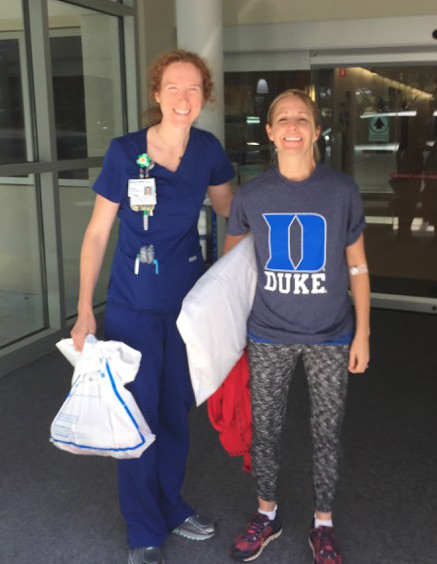
Carrie with a nurse at Duke

Carrie was referred to specialists at Duke, where a team quickly developed a treatment plan. She underwent surgery to remove the right middle and upper lobes of her lung and began the recovery process.

"It just fascinates me that something the size of a pea was discovered, and was removed so I could live."

Since then, Carrie has had several follow-up tests, all of which have come back cancer free.

"It was a blessing in disguise, more than anything you could imagine, this gift of life," she said. "The opportunity to raise my children and be a wife."

Though she hasn't met the radiologist who discovered the tumor, Carrie knows exactly what she would say.

"If I were to say thank you to the folks at HMG, I would be speechless. I would want to have my kids with me and let them say thank you as well. Does that one person know they saved my life? I would just say thank you for giving me the chance to be a mom."

Carrie encourages everyone to talk with their healthcare provider about whether a cardiac CT calcium score is right for them. When it comes to your health, early detection can make all the difference.

Health Matters Blog logo

Subscribe

Sign up for health tips, wellness advice and more, straight from our providers.

Subscribing indicates your consent to our terms of use and our privacy policy. You can unsubscribe anytime.

More on prevention

Colonoscopy prep and what to expect

Colonoscopy prep and what to expect

It is not the old two-gallon jug anymore

Cervical health: Making yourself a priority

Cervical health: Making yourself a priority

Learn why cervical cancer screening matters, even when you feel fine. Discover prevention, risk factors, and how early detection can save lives.

Is your family ready for flu season?

Is your family ready for flu season?

Prepare your family for flu season by avoiding people who are sick, spotting signs of a flu, getting your flu shot, and knowing when to call your HMG provider.